


Brembo Racing Brake System: Brake Fluid, Bleeding, Brake Balance and Maintenance
A perfectly installed caliper is only half the story. How well a racing brake system performs on track depends just as much on the brake lines, the fluid, correct bleeding, a well-set brake balance and consistent checks after every event. Here you will find the recommendations from the Brembo Racing Caliper Catalogue 2026 in a compact, practical format.
Maintenance at a glance
| Topic | Recommendation |
|---|---|
| Brake fluid | high-boiling DOT 3 / DOT 4 only, from a new sealed container; change before every race |
| Max. caliper temperature | below 200 °C (checked with thermal strips) |
| Brake bias via balance bar | adjustment up to max. 10 % |
| Replace the disc if | cracks > 5 mm, any crack starting at inner/outer edge, or 1 mm wear (0.5 mm per side) |
| Minimum friction material | 2 mm |
| Uneven pad wear (tangential/radial) | max. 1 mm difference |
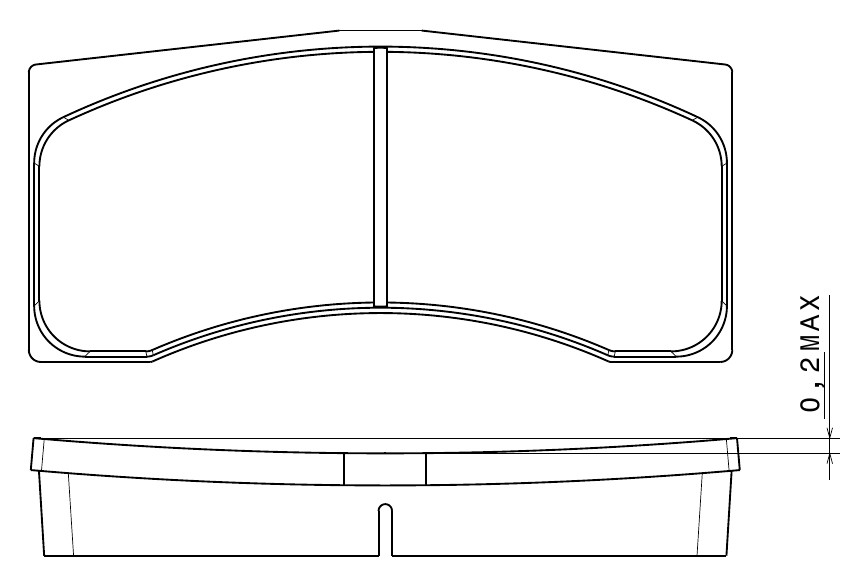
| Pad back plate flatness | max. 0.2 mm deviation |
| Overhaul of master cylinders and calipers | after 5,000 km at the latest |
Brake lines and hoses
- Wherever possible, use rigid steel lines – they add no fluid absorption and give a direct pedal feel.
- Where flexible hoses are needed, use PTFE (Teflon) hoses with a braided steel sheath.
- Check the hose supplier's data for volume absorption. Larger hose diameters considerably increase the absorption of the whole system.
Fitting the lines
- Tighten fittings to the specified torque.
- Seal fittings with annealed aluminium or copper washers – these are single-use only.
- Make sure lines are not crushed or kinked and are kept away from hot areas such as the engine or exhaust.
Choosing the right brake fluid
- Use only high-boiling DOT 3 or DOT 4 brake fluid.
- Only use fluid from a new, sealed container.
- Change the fluid before every race.
Any fluid other than brake fluid will damage the system components. Because brake fluid is hygroscopic – it absorbs moisture from the air – its boiling point can drop significantly in humid conditions. In that case it should be replaced daily.
Bleeding the brake system correctly
- With two parallel master cylinders operated by a balance bar, bleed one front and one rear caliper at the same time so that both cylinders can complete their full stroke.
- After each pedal stroke, let the pedal return and wait at least 2 seconds so that both master cylinders refill simultaneously.
- Once bleeding is complete, hold the system under pressure for at least 10 seconds and check for leaks.
- Top up the reservoirs.
Bedding-in and final inspection
- There must be no contact whatsoever between disc and caliper.
- Follow the pad manufacturer's instructions for the bedding procedure.
- The maximum caliper temperature must stay below 200 °C – verified with the thermal strips applied to the calipers.
- Check the disc operating temperature using the thermal paint on the disc's outer diameter.
Checks after the first few kilometres
- The wheels must turn freely without residual drag.
- Disc and caliper must not touch.
- No pulsation should be felt at the pedal. If there is, identify the affected disc and re-check the disc/bell and bell/hub assemblies.
Setting the brake balance
The brake system must be matched to the vehicle. The key is that maximum braking power is distributed evenly between the front and rear axle. A good sign of a well-balanced system: front and rear brakes reach similar operating temperatures.
The balance bar only allows the brake bias to be shifted by up to 10 %. The pedal force should always act close to the centre of the bar for the pedal mechanism to work efficiently. If balance cannot be achieved this way, the cause lies elsewhere – e.g. master cylinder bore, caliper type or disc diameter. Before replacing parts, check whether the combination of components is right. Rule of thumb: the loads and strokes of the master cylinders should be as similar as possible.
Inspection after every race
Fittings
Check all components, connections and fittings for leaks. If a fitting leaks, increase the tightening torque or replace the faulty part.
Brake discs
A cast-iron disc must not be reused if:
- the friction surface shows cracks longer than 5 mm – if a crack starts at the inner or outer diameter, the disc must be replaced even if the crack is shorter,
- it has worn 1 mm compared with its new thickness (0.5 mm per side),
- the friction surfaces show damage that impairs proper pad/disc contact.
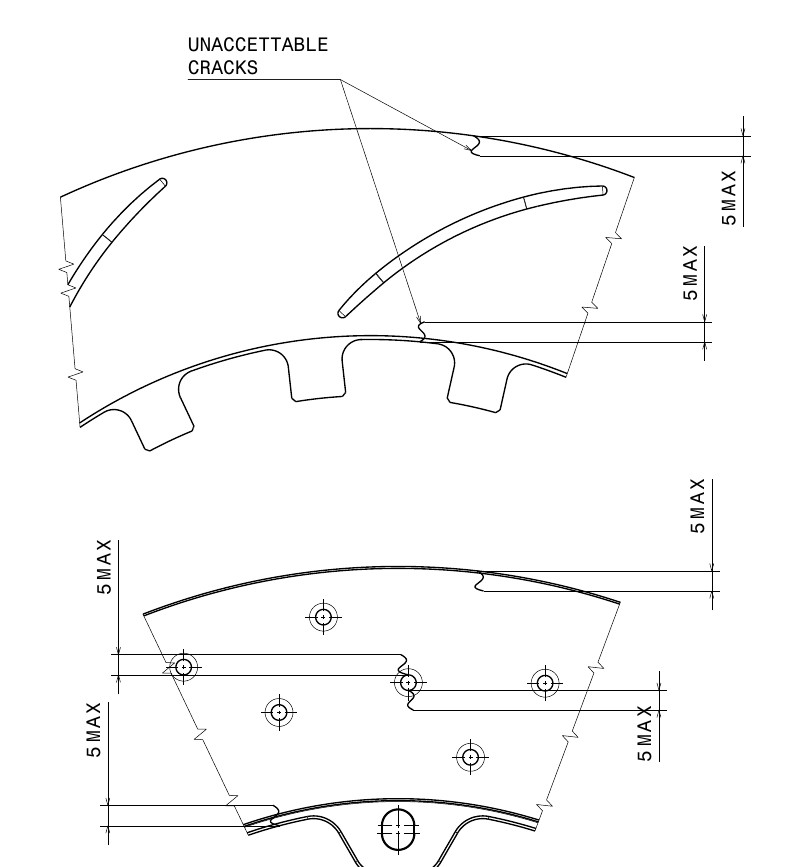
Good to know: cracks at the outer diameter usually indicate very high temperatures, while cracks at the inner diameter typically appear when the disc was not bedded in correctly.
Calipers
- Check calipers and connections for damage from stones or debris and replace any damaged parts.
- Read the peak temperature on the thermal strips on the inner caliper half. If 200 °C has been reached, Brembo recommends servicing the caliper.
Brake pads
Friction material must not be thinner than 2 mm. There must also be no markedly uneven wear: the difference in tangential and in radial taper wear must each be no more than 1 mm. The wear direction within one caliper must match the illustration.
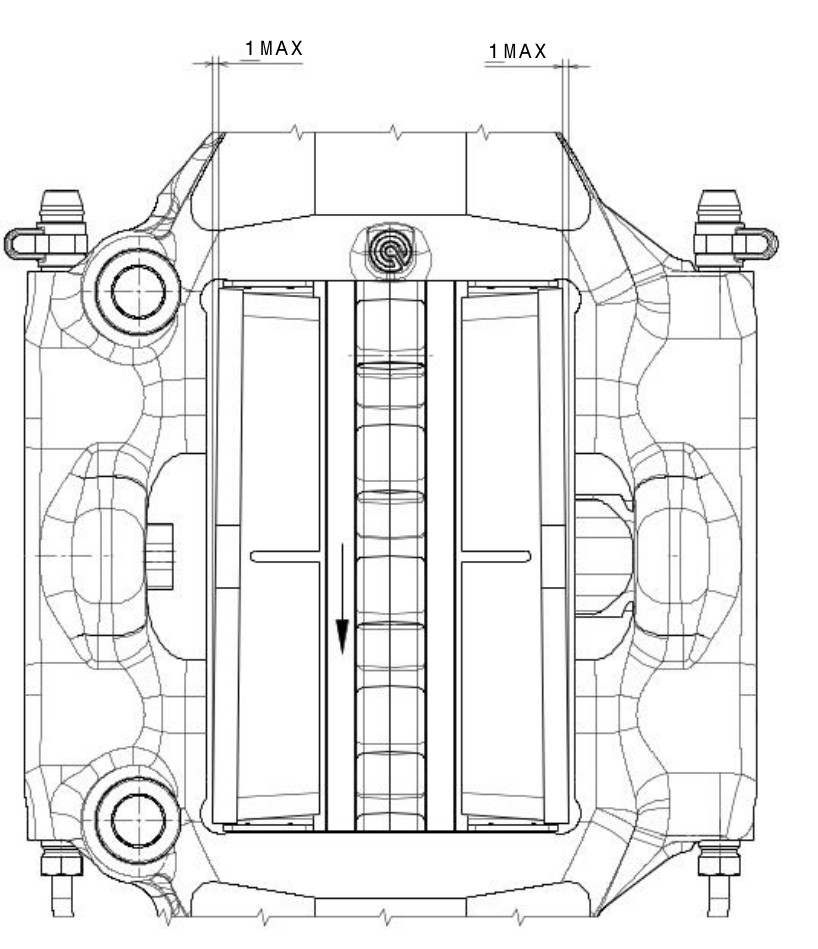
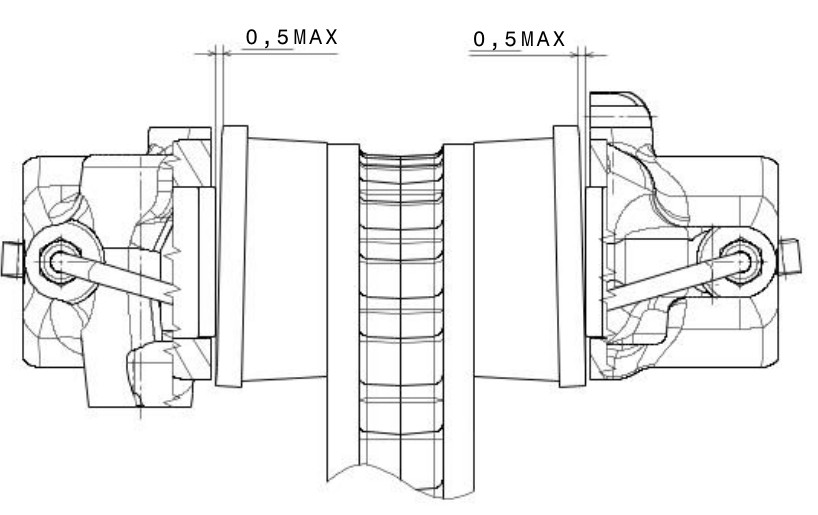
Back plate flatness error must not exceed 0.2 mm. If it does, or if pads are damaged or excessively worn, they must be replaced.
General notes
- Clean master cylinders and calipers only with non-corrosive agents – never solvents or petrol, which attack seals and dust boots.
- During storage, close the inlet and outlet ports of master cylinders and calipers with suitable caps.
- Caliper half bolts must not be undone and re-tightened, and calipers must not be modified.
- Using non-genuine parts is not permitted and voids the Brembo warranty.
- Brembo recommends having overhauls carried out by authorised personnel.
Service intervals
Master cylinders and calipers should be overhauled after 5,000 km at the latest – or earlier if problems occur. For calipers this also applies as soon as the thermal strips show temperatures above the permitted range.
Frequently asked questions (FAQ)
How often should brake fluid be changed in motorsport?
Brembo recommends changing it before every race – and even daily in high humidity.
Which brake fluid for Brembo Racing calipers?
High-boiling DOT 3 or DOT 4 from a new, sealed container.
How hot may a racing caliper get?
Caliper temperature should stay below 200 °C. If this value is reached, a service is recommended.
When must a racing brake disc be replaced?
With cracks over 5 mm, any crack at the inner or outer edge, 1 mm total wear or damage to the friction surface.
When are racing brake pads worn out?
With less than 2 mm friction material, more than 1 mm taper wear or back plate flatness error above 0.2 mm.
How often do Brembo Racing calipers need an overhaul?
Every 5,000 km at the latest, or when problems or overheating occur.
Note: Brembo Racing components are intended exclusively for motorsport use and are not approved for public roads. Installation and maintenance should be carried out by qualified professionals. The information is based on the Brembo Racing Caliper Catalogue 2026 and is provided for guidance – the instructions supplied with the product always take precedence.
Seal kits, pistons and other spare parts for overhauling your Brembo Racing calipers are available from us – just get in touch.
Questions about installation, maintenance or spare parts? Contact us – we are happy to help.


